
 Mayur Bhatasana
Displaying the same product across five different marketplaces means five spreadsheets, five different images, and five times the possibility of getting the price wrong somewhere. Our product information management software eliminates that by delivering the same data correctly to every channel.
We looked at the leading catalogue management platforms available today by analysing their pricing pages, G2 review data and search visibility in 2026 to determine how they appear to teams researching this category in 2026. Here’s what we found.
Top 3 Picks
| Platform | Best For |
| Akeneo | Enterprise teams with large, complex product catalogues |
| Plytix | Small and mid sized businesses that want PIM and DAM in one affordable tool |
| Sales Layer | Teams that need to get a catalogue live and publishing fast |
On the list below, we have Feedonomics and Pimcore one is designed for multichannel product feeds, the other, for teams who want to keep tight control in an open-source implementation.
Catalog Management Software: What It Does
Catalogue management software enables companies to centrally manage product information across multiple sales channels. It categorises items into families, attributes, variants, SKUs, and product categories, and allows for product data enrichment with images, specifications, descriptions, and content.
They can also facilitate automatic publishing and refreshing across multiple channels, allowing companies to keep their product data accurate, complete and consistent.
Why Businesses Need Catalogue Management Software
Handling a large catalogue via spreadsheet can be very laborious, particularly where products are available through multiple channels. Catalogue management software reduces data entry errors, ensures consistent product descriptions, enables quick updates and removes redundant effort.
It can enhance product searchability through more detailed data and reduce time to market. For fast-growing companies, centralising catalogue functions provides a more practical way to handle increasing SKU numbers without adding unnecessary processes.
How We Compared These Platforms
For each of these catalogue management solutions, we examined ten key aspects: product data management, catalogue structuring, data enrichment, multichannel publishing, marketplace integration, workflow automation, digital asset management, ease of use, scalability and cost.
Our review considered how each platform performs the basic tasks of managing the catalogue daily, and whether it can scale to accommodate large quantities of products, complex distribution needs and other demands that grow over time. Those software packages that performed well across these criteria made it into our final selection.
Best Catalogue Management Software Compared
| Tool | Rating | Best For | Key Features | Starting Price |
| Akeneo | 4.4/5 (G2) | Complex product catalogues | Bulk actions, AI enrichment, rules engine, syndication | 45,000 Dollars per year (Growth) |
| Sales Layer | 4.6/5 (G2) | Fast catalogue publishing | Auto-mapped fields, price calculation, quality dashboards | From $1,000/month |
| Plytix | 4.7/5 (G2) | Small and mid sized businesses | PIM + DAM in one, free AI tools, Shopify workflows | Free plan; paid from €499/month |
| Feedonomics | 4.4/5 (G2) | Multichannel product feeds | 400+ channel reach, order sync, feed specialist support | Custom (quote-based) |
| Pimcore | 4.4/5 (G2) | Open-source flexibility | Open-core PIM/MDM/DAM, unlimited entities, full source access | Free Community Edition; paid from $9,900/year |
5 Best Catalogue Management Software
1. Akeneo
Rating: 4.4/5 (G2)
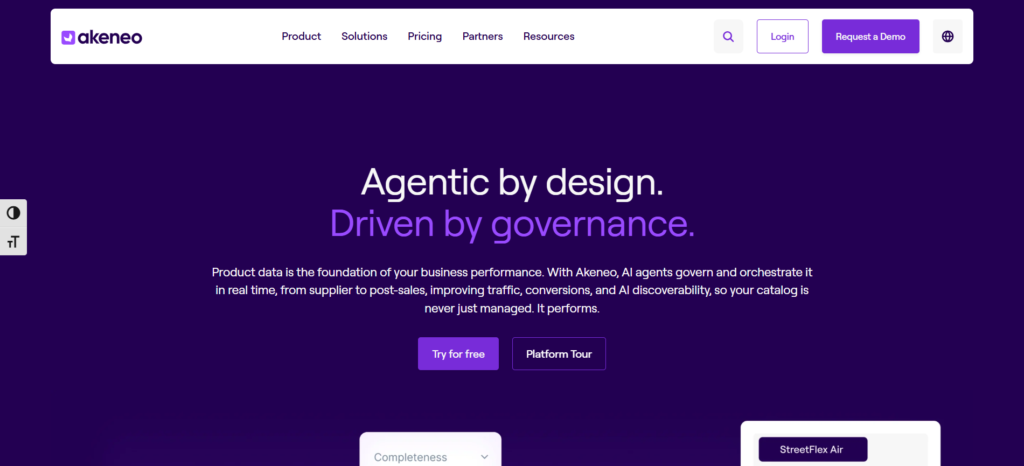
Akeneo is a popular PIM system designed to offer organisations a single source of truth for product data across all sales channels. It is API-enabled, and its open-core architecture facilitates catalogue modelling, enrichment, validation, and export and accommodates the needs of both small startups and enterprise catalogues with hundreds of thousands of SKUs.
What differentiates Akeneo is the AI enrichments, translations, and localisations, with a rules engine to take care of the boring parts. Readers on G2 also mention bulk editing and multi language features but highlight the fact that the price can escalate fast once you add channels and advanced features.
Key Features:
- Bulk actions and a rules engine for automated data cleanup
- AI powered enrichment, translation, and localisation
- Validation workflows and completeness dashboards
- Reference entities for managing rich content alongside products
- Open, API-driven architecture for custom integrations
Pros:
- Handles highly complex, large-scale catalogues well
- Strong multi-language and multi-channel support
- Free, open-source Community Edition available
- Detailed permissions, versioning, and rollback controls
Cons:
- Growth SaaS pricing is 45,000 Dollars per year, which is too expensive for most SMBs.
- Many advanced features are paid add-ons on top of the base price
- Initial setup can require technical expertise
- Analytics capabilities are rated weaker than other areas
Pricing:
- Growth: Starting at $45,000/year
- Enterprise: Custom pricing: Contact sales for a quote
2. Sales Layer
Rating: 4.6/5 (G2)
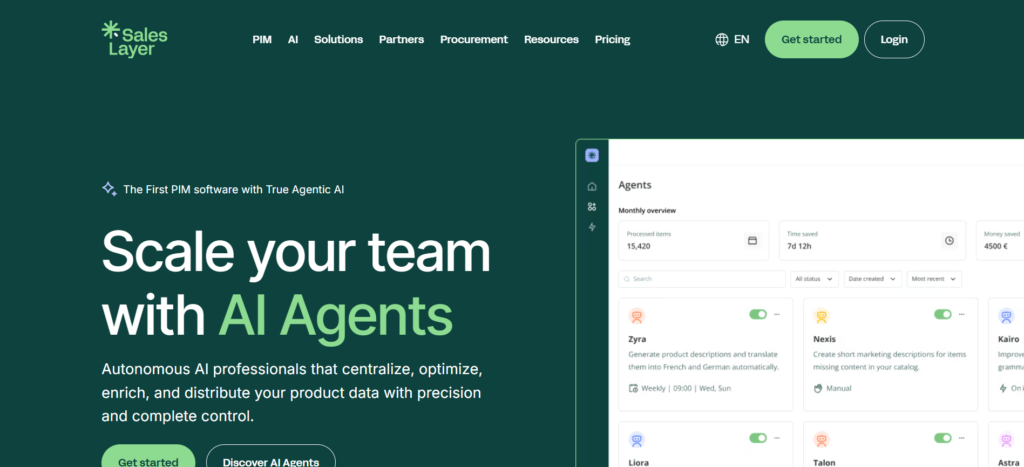
Sales Layer is a cloud PIM that helps product catalogues stay organised and quickly publication ready, with a short implementation cycle. It auto-maps the fields to the right attributes, categories, and product families (something that users on G2 commonly say saves them a lot of time on a spreadsheet workflow).
Designed to run your E-Commerce, Retail or Manufacturing team that needs to synchronise product data across web shops, marketplaces and ERPs in near real-time. It is quick to get set up – said to be generally six weeks, making it a good choice if you can’t afford to wait for months until your live catalogue is up.
Key Features:
- Automatic field mapping to attributes, categories, and families
- Real-time collaboration with role-based permissions
- Price calculation based on supplier currency and exchange rate
- Data quality dashboards with visual completeness reports
- Native connectors for websites, marketplaces, and procurement platforms
Pros:
- Fast onboarding and intuitive day-to-day editing
- Strong data quality and cleansing tools
- Handles millions of SKUs despite a simple interface
- Highly rated customer support on G2
Cons:
- Starting price is steep for very small catalogues
- Some advanced pricing logic must be handled outside the core PIM
- Fewer enterprise governance features than Akeneo
- Full pricing requires a custom quote beyond the base tier
Pricing:
- Scale: Custom pricing — Contact sales for a quote
- Premium: Custom pricing — Contact sales for a quote
- Enterprise: Custom pricing- Contact sales for a quote
- Enterprise Plus: Custom pricing — Contact sales for a quote
3. Plytix
Rating: 4.7/5 (G2)
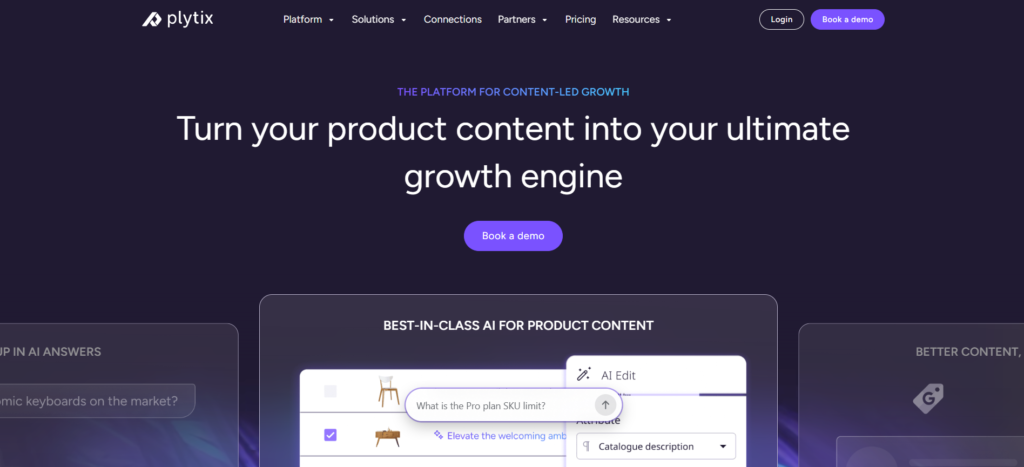
Plytix is a combination of PIM, digital asset management and feed management integrated on a single platform designed specifically for developing and mid-market e-commerce organisations. It is rated the easiest to use PIM on G2, and has free AI-powered tools for translation, image editing, and content creation on all plans-a rarity for this category.
It’s built for teams that own their own product data on a daily basis without requiring it to go to IT every time you make a change. Native Shopify workflows, bulk editing, and completeness scoring make it a natural fit for companies who moved on from spreadsheets but are not enterprise PIM size.
Key Features:
- Combined PIM and DAM with no separate DAM contract needed
- Free AI tools included on every plan (translation, image editing)
- Native Shopify integrations with bulk editing and completeness scoring
- Predefined channel templates for fast, accurate publishing
- Unlimited users and a dedicated account manager on paid plans
Pros:
- Rated the easiest PIM to use on G2
- Genuinely affordable compared to enterprise PIM options
- Free plan available for smaller catalogues
- Excellent, responsive customer support per reviews
Cons:
- Less suited to businesses needing heavy customisation or complex governance
- Not built for setups where IT owns day-to-day catalogue changes
- Smaller enterprise feature set than Akeneo or Pimcore
- Some advanced workflow automation lives in higher tiers only
Pricing:
- Standard: €0/month — 500 SKUs
- Pro: €499/month — 50,000 SKUs
- Enterprise: Custom pricing: Contact sales for a quote
4. Feedonomics

Rating: 4.4/5 (G2)
Feedonomics is a total product feed management software solution that enables merchants to manage and optimise their product listings on hundreds of different shopping platforms such as Google Shopping, Amazon, Meta, TikTok, and Walmart. The feed technology is complemented by Feedonomics’ team of feed specialists who are responsible for installation, optimisation, and troubleshooting.
Brands such as Cole Haan, Perry Ellis, and Puma use Feedonomics to boost ROAS and expand reach through centralised multichannel commerce. It’s more than a self-serve PIM and more like a fully managed catalogue syndication engine, making it the best choice for teams where the biggest roadblock is getting today’s products, formatted properly, for every channel.
Key Features:
- Reach across 400+ shopping channels and marketplaces
- AI-enriched feed optimisation and catalogue listing automation
- Two-way marketplace order sync and order orchestration
- Dedicated feed specialist support included
- Real-time data synchronisation with twice-daily feed imports
Pros:
- Best-in-class channel reach for multichannel sellers
- Hands-off, managed service reduces internal workload
- Strong data cleansing and synchronisation ratings
- Trusted by well-known multichannel retail brands
Cons:
- No published pricing every engagement is a custom quote
- No free plan or self-serve option
- Cost only makes sense at meaningful catalogue scale
- Less useful as a standalone PIM for internal data governance
Pricing:
Custom. Based on quote pricing and relies on SKU volume, channels and service level. No public free trial; demo available.
5. Pimcore
Rating: 4.4/5 (G2)
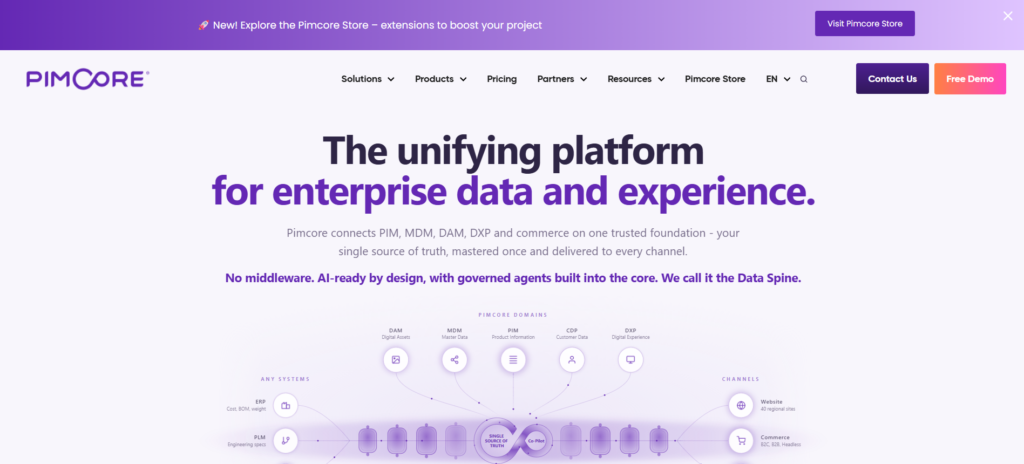
Pimcore is an open-source enterprise product information management (PIM), master data management, digital asset management and content/commerce tool in an open-core architecture. The community edition is free and, in some instances, is suitable for production use. It allows teams to fully access the source code for bespoke development and internal innovation.
For enterprises that need complete control over their catalogue infrastructure, or that already have developers in-house, Pimcore provides the flexibility that SaaS PIMs lack. Paid Professional and Enterprise editions include commercial licensing, long-term support, workflow automation, and product syndication to help you scale your business.
Key Features:
- Combined PIM, MDM, DAM, and DXP in one open-core platform
- Full source code access for custom development
- Unlimited entities, data, and users on every edition
- Workflow designer, automation, and data quality management
- Product data syndication and marketplace integration tools
Pros:
- Free, open-source Community Edition with real functionality
- No vendor lock-in and full ownership of your data and IP
- Strong asset management ratings on G2
- Highly flexible for businesses with custom technical needs
Cons:
- Free tier is restricted to non-production, academic, or sub-$5M revenue use
- Requires more technical setup than SaaS-first competitors
- Paid tiers add up quickly once hosting and support are included
- Best value depends on having in-house development capacity
Pricing:
- Professional: $9,900/year — On-premises
- Enterprise: $29,900/year — On-premises
- PaaS: From $39,900/year — Managed cloud platform
- Community: Free — Available for eligible organisations
Catalog Platforms for Different Business Requirements
The suitable Product Catalogue Management Platform varies on the size of your catalogue, the number of sales channels you have and how you operate. If you need to have a complex product information management for multiple markets, Akeneo is a good option. On the other hand, Sales Layer is a good alternative for faster publishing of your catalogue.
Plytix is a hybrid PIM / DAM solution for SMBs, Feedonomics is designed for multichannel marketplace selling, and Pimcore can be more technically adaptable for companies with specific needs.
Features to Compare Before Choosing
Consider how each catalogue platform handles the product lifecycle. When it comes to product data, look at product attributes and variations, bulk editing, data validation, taxonomy management, channel syndication, marketplace integrations, and multilingual capabilities.
Digital asset management and creative management platforms, especially for managing product images and media, are also crucial. Companies should look at workflow controls, approval routing, etc. To confirm that the teams can efficiently and consistently manage large volumes of accurate, channel-ready product data.
Catalog Management vs. Product Information Management
They are often used synonymously, but they are not the same. Catalogue Management is more about set-up & publishing of product content (categories & structures and placements in channels), while Product Information Management (PIM) manages the content and data itself in a central place before it is shipped to the channel.
Today, all of the tools listed here support both: centralising the information, creating enriched content around the product data, as well as multi-channel publishing, all in a single solution.
Catalog Management Software Pricing and Plans
Catalog Management Software Pricing depends on catalogue size, usage, features, and business needs. Some solutions provide free or open-source options, whereas others have product-based, usage-based, or subscription pricing.
For enterprise solutions, expect custom pricing depending on scope of implementation, integrations, users, support, and number of Catalogues. Make sure to compare the total cost, especially on the follow-on items: channels, feeds, storage, integrations and advanced capabilities.
Choosing a Catalog Management Platform
Begin by doing a check on the size of your current catalogue, the growth projection and sales channels. Analyse data needs for your products and review integrations with existing ERP, CMS, e-commerce and storefronts. Think about workflow automation, localisation and multilingual support if doing business across markets.
Finally, match the pricing, scalability, implementation needs and support options with your projected two- to three year growth so that the platform will continue to meet your needs as your catalog develops.
Catalog Management Trends to Watch in 2026
In 2026, catalogue management is largely automated, with AI enrichment, categorisation and product description generation saving labour. Real-time synchronisation is growing in importance, as many companies sell through multiple channels.
Automated data quality validation can catch issues early on before products go live, and omnichannel syndication is reducing the proliferation of feed management. Product data is also broadening from online shopping and e-commerce to enable retail, print, B2B and additional customer-facing catalogue experiences.
Final Verdict
There is no one size fits all “best” product for managing catalogues. The right product depends on your catalogue size, technical capabilities, and channel mix. Akeneo or Pimcore are best suited for enterprise teams with complex multi market catalogs.
If you’re an expanding e-commerce brand looking for something affordable and simple to operate in your daily business, Plytix or Sales Layer should be your first choice. And if your true pain point is properly standardising your current data across dozens of marketplaces, Feedonomics was designed for this very purpose.
FAQs
1. What is catalog management software?
Catalog management software brings together product data to include attributes such as descriptions, specifications, images and pricing, which a business can then use as the basis for producing and distributing uniform, detailed listings to all their sales channels from one location.
2. What is the best catalog management software?
When it comes to the broadest, most complicated enterprise catalogues, Akeneo is the top option; Plytix excels for small and mid sized businesses; and Sales Layer is the best solution for rapid and simple publishing. The critical factors are the size of your catalogue and technical assets.
3. What is the difference between PIM and catalogue management?
PIM addresses the unification and enhancement of the core product information itself, whereas catalogue management is more concerned with the management and dissemination of this information to the sales channels. In most cases, both functions are combined in one modern platform.
4. How does catalogue management software improve ecommerce?
It minimises errors in product information, ensures consistency of listings across multiple channels, accelerates the time to market, and enhances product discovery by providing comprehensive and accurate information on every channel.
5. Can catalog management software sync products across multiple channels?
Yes. The majority of the listed platforms, Feedonomics and Sales Layer, in particular, are designed to automatically sync product data in real or near real time through various channels including marketplaces, advertising channels and stores.