 Mayur Bhatasana
AI Image Generation has evolved from just being a novelty to a serious part of the creative and commercial process. AI image generators in 2026 make cinematic concepts, advertisements, product renderings, and text images. There is no one AI image generator that is the best across all fields.
AI image generators now offer features like conversational editing, layouting, and images for style or character referencing. This paper examines five best AI picture generators on the grounds of picture quality, text generation, editing, commercial security, and pricing.
Top 3 Picks at a Glance
| Rank | AI Image Generator | Best For |
| 1 | Midjourney | Cinematic & artistic visuals |
| 2 | ChatGPT (GPT Image 2) | Beginners & conversational creation |
| 3 | Adobe Firefly | Commercial & professional design |
These three tools cover the most common creative needs. Midjourney excels in visual style, ChatGPT offers easy conversational creation, and Adobe Firefly is well suited for businesses requiring commercially focused image generation.
Core Capabilities of AI Image Generators
Strong AI image generators combine several capabilities beyond basic text-to-image creation, making them useful AI tools for graphic designers working on complex creative projects. Key factors include prompt understanding and accuracy, photorealistic image generation, precise image editing, and readable text and typography. Users should also consider style and composition control, along with customisation through reference images, fine-tuning, or self-hosting.
These capabilities determine how effectively a platform handles complex creative requirements, maintains visual consistency, and produces professional results, separating advanced AI image generation platforms from basic novelty tools.
Quick Comparison of the 5 Best AI Image Generators
| AI Image Generator | Rating | Best For | Standout Feature | Pricing |
| Midjourney | 4.7/5 | Cinematic and artistic visuals | Unmatched aesthetic range and style control | $10–$120/mo, no free tier |
| ChatGPT (GPT Image 2) | 4.6/5 | Conversational image creation | Natural-language editing with a reasoning layer | Free tier; Plus $20/mo; Pro $100–$200/mo |
| Adobe Firefly | 4.5/5 | Commercial creative work | Full commercial copyright indemnification | Free tier; $9.99–$199.99/mo |
| Ideogram | 4.5/5 | Typography and text rendering | 90%+ accurate in-image text | Free tier; $7–$42/mo |
| FLUX | 4.4/5 | Open-source flexibility | Self-hostable, open-weight models | Free (open-weight); pay-per-image API |
Our Criteria for Comparing AI Image Generators
We evaluated each tool across nine factors:
- Image quality and visual fidelity
- Prompt accuracy
- Photorealism
- Text rendering
- Editing capabilities
- Creative control
- Ease of use
- Commercial usage
- Pricing and value
5 Best AI Image Generators in 2026
1. Midjourney – Best for Cinematic and Artistic Visuals
Rating: 4.7/5
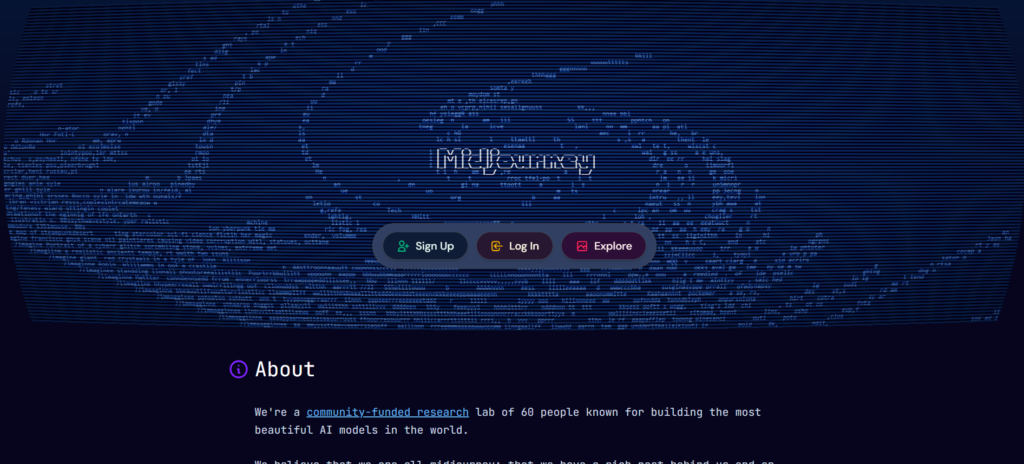
Midjourney remains a benchmark for artistic, stylized image quality. Its web interface makes image creation accessible, while its latest models deliver cinematic and painterly visuals in seconds. With the presence of a large number of creative individuals, the software is widely used in creating concept art, book cover art, and illustration art.
While the Omni Reference feature of Midjourney allows characters to be consistent across generations, its flexible artistic style appeals to artists. However, it offers less control over layouts and still trails specialist tools in text and typography generation.
Standout Features
- Omni Reference for consistent characters across multiple generations
- Wide artistic style range, from photorealism to painterly and anime looks
- Fast, Relax, and Turbo generation speeds to manage GPU usage
- Stealth Mode for keeping generations private (Pro and Mega plans)
- Native short-form video animation from generated or uploaded images
Pros
- Best-in-class aesthetic and artistic quality
- Strong style consistency across a full project or series using creative management platforms
- Active community and extensive prompt-engineering resources
- Relax Mode offers unlimited (if slower) generation on paid plans
Cons
- No free tier or free trial of any kind
- Text rendering is weak, typically 30–40% accuracy on embedded words
- Pricing is based on GPU time, not a fixed image count, which can confuse new users
- Free-tier generations from Basic and Standard plans appear publicly by default
Pricing
Midjourney provides four options for plans, which include Basic, Standard, Pro, and Mega. You have an option to pay on a monthly or yearly basis.
2. ChatGPT – Best for Conversational Image Creation
Rating: 4.6/5
ChatGPT Images 2.0 built with GPT Image 2 by OpenAI should be more focused on “ongoing conversation” not necessarily requiring complex prompts to generate images. Users should be able to ask for a change of colors or movement of objects easily. It is ideal for beginners, marketers, and fast creative iteration.
Its Thinking mode helps plan complex compositions, while web search can support detailed requests. Another major strength is multilingual text rendering, making it useful for global marketing campaigns requiring accurate text and typography.
Standout Features
- Conversational, natural-language image editing and refinement
- Thinking mode that plans layout and composition before rendering
- Multilingual text rendering across five non-Latin scripts
- Support for up to 16 reference images per generation
- Batch generation of up to 8 coherent images from a single prompt
Pros
- Extremely easy to use with no prompt-engineering learning curve
- Strong, accurate text rendering across multiple languages
- Included in an existing ChatGPT subscription, no separate tool needed
- Good balance of realism, prompt accuracy, and typography
Cons
- Free tier is limited to roughly 3 images every 24 hours
- Thinking mode, the most useful feature, requires a paid plan
- Trails specialists like Midjourney on artistic style range
- API pricing is billed separately by token, which can surprise developers
Pricing
- Free: ₹0/month
- Go: ₹399/month
- Plus: ₹1,999/month
- Pro: From ₹10,699/month
3. Adobe Firefly – Best for Commercial Creative Work
Rating: 4.5/5
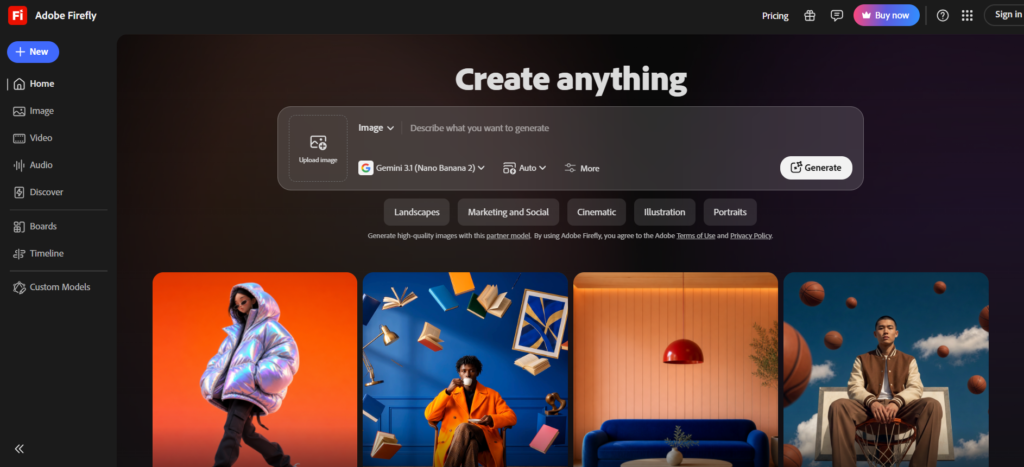
Adobe Firefly is designed for commercial safety, using licensed Adobe Stock images, openly licensed content, and public domain material for training. It offers commercial usage rights and, on eligible plans, IP indemnification. For businesses, agencies, and Creative Cloud customers who want to generate images within Photoshop, Illustrator, or Express, Firefly is a perfect tool. Firefly’s most recent model provides ultra-realistic, high-quality images with layer-aware, prompt-based editing. With support for 30+ partner models, Firefly also works as a hub for image editing and refinement.
Standout Features
- Full commercial usage rights with IP indemnification on eligible plans
- Native integration with Photoshop, Illustrator, and Express
- Generative Fill and Expand for context-aware photo editing
- Firefly Image Model 5 for native 4MP photorealistic output
- Access to 30+ partner models, including FLUX and Ideogram, in one subscription
Pros
- Only major tool offering full commercial copyright indemnification
- Deep, genuinely useful integration across Adobe’s creative apps
- Free tier allows commercial use, unlike most competitors
- Standard-resolution generations are unlimited on every paid plan
Cons
- Premium credits (video, high-res, partner models) get consumed quickly
- Higher tiers (Pro Plus, Premium) are expensive relative to competitors
- Artistic range is narrower than Midjourney’s for purely creative work
- Credit system takes some time to understand fully
Pricing
- Standard: ₹797.68/month — 2,000 credits.
- Pro: ₹1,596.54/month — 4,000 credits.
- Pro Plus: ₹2,791.94/month — 10,000 credits.
- Premium: ₹11,169.40/month — 50,000 credits.
4. Ideogram – Best for Typography and Text Rendering
Rating: 4.5/5
Ideogram Former Google Brain researchers founded Ideogram to help fill a significant AI image Ideogram A team of former Google Brain researchers established Ideogram to address a major hole in AI image generation – the generation of understandable text within images.
Ideogram has excellent text accuracy and is best suited to marketers, designers, and print-on-demand companies working on branding and design tools such as posters, logos, infographics, and social graphics.. While text is by far the greatest strength of Ideogram, Ideogram v3 offers excellent prompt compliance and photorealism but occasionally struggles a little with human faces, compared with Midjourney.
Standout Features
- 90%+ accurate embedded text rendering across multiple languages
- Style Reference tools for guided, consistent visual output
- Batch generation for producing design variations quickly
- Public API with per-image pricing, separate from web subscriptions
- Support for Spanish, French, German, and Japanese text rendering
Pros
- Best-in-class text accuracy for posters, logos, and ads
- More affordable than Midjourney at comparable usage volumes
- Genuinely usable free tier for testing before committing
- Strong prompt adherence alongside its typography strength
Cons
- Photorealistic human faces are less consistent than Midjourney’s
- Free-tier generations post publicly and can’t be deleted
- Credit consumption varies significantly by model and quality setting
- Batch generation, useful for production teams, requires the Pro plan
Pricing
- Plus: $15/month (annual) — 1,000 credits/month.
- Pro: $42/month (annual) — 3,500 credits/month.
- Team: $20/user/month (annual) — 1,500 credits/user/month; minimum 2 users.
5. FLUX – Best for Open-Source Flexibility
Rating: 4.4/5
FLUX , developed by Black Forest Labs, offers open-weight models that can be self-hosted or accessed through a pay-per-image API. Its lineup includes Schnell, Dev, and the newer FLUX.2 family. Ideal for engineers and technical teams who want to manage cost, deployment and customization. FLUX.2 enhances photorealism, in-image text, and prompt comprehension and accuracy, making it a compelling substitute for closed source models in self-hosted or API workflows.
Standout Features
- Open-weight models (Schnell and Klein) under the Apache 2.0 license
- Self-hostable for full control over cost and data privacy
- Credit-based API pricing that scales with output resolution
- FLUX.2 Pro and Max for commercial-grade, hosted generation
- Strong photorealism and improved typography in the FLUX.2 family
Pros
- No subscription required; pay only for what you generate or host yourself
- Full data control when self-hosted, ideal for privacy-sensitive work
- Apache 2.0 licensed variants can be used and modified freely
- Competitive photorealism and prompt adherence versus closed models
Cons
- Requires technical setup for self-hosting; not beginner-friendly
- No polished consumer app or web UI comparable to Midjourney or ChatGPT
- FLUX Dev’s open-weight license is non-commercial by default
- Higher-tier models (Pro, Max) still require paid API access
Pricing
- FLUX 3 Video Draft: $0.06/s (HD), $0.12/s (FHD) — Fast, low-cost exploration.
- FLUX 3 Video: $0.17–$0.53/s — Balances quality, cost, and speed.
AI Image Generators for Different Creative Needs
Different types of creative projects require different types of image generator AI programs. For example, Midjourney is great for cinematic and artistic story-telling purposes, whereas ChatGPT provides the simplest way to make conversational images. Adobe Firefly suits commercial and professional design with added safety features. Ideogram stands out for typography-heavy graphics, including posters, logos, and advertisements. For photorealistic, customised visuals, FLUX gives technical teams greater control through open-weight models, flexible deployment, and customisation options.
Image Quality, Editing and Creative Control Compared
AI image generators are very different in terms of quality, editing options, and creativity control. Midjourney has great skills for creating artistic images and realistic style. ChatGPT allows users to edit conversations and interpret prompts easily. Adobe Firefly provides powerful professional editing tools, including Generative Fill. For text-based designs, ideogram is a better choice, whereas FLUX provides greater flexibility for technical people. The choice of the software should depend upon the requirements of creativity and flexibility.
Choosing the Right AI Image Generator
Selecting an appropriate image generator is determined by what you are looking to do and your budget among other factors. The Midjourney is good for artistic images whereas FLUX and ChatGPT are better for photorealistic images. Adobe Firefly works well for commercial projects and Creative Cloud users. Ideogram is the best choice for designs that are text intensive. Make sure you compare free plans, cost, generation limit, usability, and customization ability to pick the most suitable tool for your needs.
Final Verdict
Keep in mind that there is no one-mode fit AI image generator in the creative arts realm. With another catchphrase, Midjourney excels at creating cinematic images while ChatGPT is text-based and excels at chat-style creation.Adobe Firefly shines when it comes to commercial design, whereas Ideogram is known for typography generation, and FLUX stands out due to its flexibility and customization options. With regards to market trends, it is becoming increasingly specialized, thus requiring multiple generators’ use for various projects.
Frequently Asked Questions
1. What is the best AI image generator in 2026?
Midjourney leads for artistic quality, ChatGPT for ease of use, and Adobe Firefly for commercial work.
2. Which AI image generator creates the most realistic images?
FLUX.2 and ChatGPT GPT Image 2 produce with fotorealistyczne, with FLUX giving larger Technical Git.
3. Which AI image generator is best for text?
Ideogram is the top choice for accurate embedded text, while ChatGPT performs strongly with multilingual text.
4. Which AI image generator is best for commercial use?
Adobe Firefly emerges as an excellent option owing to its use of licensed training material and indemnification on eligible plans.
5. Are AI image generators free?
Some provide free tiers, others like Midjourney have subscription models, while FLUX can be free self-hosted.