
 Mayur Bhatasana
Putting your company videos on a free consumer site might seem simple, but it costs you control-you lose your branding, your competitor’s ads appear alongside your video, and you get very little information about who is viewing your video. A professional business video hosting platform restores control with a branded player, robust privacy options, and useful viewing data.
We evaluate five of the top platforms this year on the aspects of hosting, player customisation, analytics, security, and pricing. Take a quick look at our Top Three choices before we jump into the full review.
Choosing the right hosting platform really depends on what you want to achieve with video and your business. Vimeo is great if you want a business hosted service; Wistia is ideal for marketing videos, while YouTube is more suited to broadcasting to the masses.
Vidyard is a good tool for sales teams, while Brightcove is a good platform for extensive broadcasting. Know that the scale of the size you wish to broadcast and access to branding, analysis, privacy and integrations should also be taken into consideration before making a choice.
Top 3 Picks at a Glance
| Platform | Best For |
| Vimeo | Professional video hosting |
| Wistia | Video marketing |
| YouTube | Public discovery |
Understanding Business Video Hosting
Business video hosting platforms provide businesses with a single repository in which they can upload, categorise, manage and publish their video content. They differ from free and consumer focused video sharing services in that they offer far more customisation options, including branding, privacy, access and player controls.
The platforms can be used to host videos on websites, landing pages, applications and intranet portals. Advanced platforms typically provide viewer analytics, engagement tracking, lead generation and integrations that enable a video to be more efficiently administered for marketing, sales, training and communication.
Enhanced platforms often offer viewer analytics, engagement tracking, lead generation and integrations, allowing a video to be more effectively managed for marketing, sales, training and communication.
Key Benefits for Business Video Teams
Advanced video hosting provides businesses the flexibility to customise how their content is branded, presented and accessed. Customizable players, privacy controls, and delivery options allow teams to keep sensitive or branded video protected while providing granular measurement of viewing behaviours, engagement, and drop off points.
Marketing teams can also generate leads right from a video, and sales teams can offer a more personal touch. These features enable a company to share video content more efficiently while also increasing engagement and security and enhancing overall content performance.
Our Approach to Comparing the Platforms
We then evaluated each of the ten key factors when considering a video hosting service to find which offered the most benefits to different business demands. These were video storage, player customisation, analytics, privacy and security, marketing, selling, integrations, collaboration, scale and cost.
We checked each platform’s official pricing sources as well, as costs can be scaled according to storage, bandwidth, number of users, features and limits on usage. It offers a more realistic comparison than just feature lists and listed prices.
Best Video Hosting Platforms Compared
| Tool | Rating | Best For | Key Features | Starting Price | Free Trial/Plan |
| Vimeo | 4.3/5 | Professional video hosting | Ad-free player, privacy controls, analytics | $12-20/mo (Starter) | Free plan available |
| Wistia | 4.6/5 | Video marketing | Lead capture, heatmaps, A/B testing, CRM integrations | Free; Business from $79/mo | Free plan (10 videos) |
| YouTube | 4.6/5 | Public discovery | Unlimited hosting, huge audience reach, live streaming | Free | Free, no paid tier |
| Vidyard | 4.5/5 | Sales videos | Personalised video, CRM-native workflows, buyer analytics | Free; Starter from $59/user/mo | Free plan available |
| Brightcove | 4.1/5 | Enterprise broadcasting | Global CDN, DRM security, AI content suite | Custom (~$20K+/yr) | Demo on request |
5 Best Video Hosting Platforms for Businesses
1. Vimeo
Rating: 4.3/5
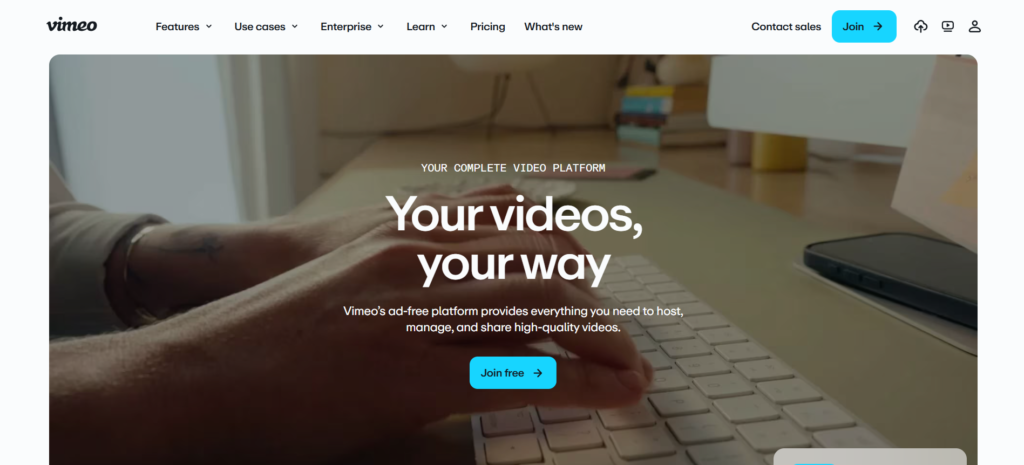
For years, Vimeo has been marketed as the “pro” alternative to more consumer-oriented sites: no ads, sharp playback, and a player you can tailor to your own site. It provides password-protected pages, detailed privacy controls, and a variety of publishing choices, so many businesses use Vimeo to distribute sleek videos without tarnishing a public feed. Storage and bandwidth scale through its Starter, Standard, and Advanced levels; above that are custom Enterprise arrangements.
The most dramatic recent change to Vimeo is the 2TB monthly bandwidth limit on self-serve plans; going over this may lead to being asked to upgrade to Enterprise. Since its acquisition in 2025 by Bending Spoons, pricing and plans have changed a few times, so it’s worth checking current limits before signing up.
Key Features:
- Ad-free, brand-controlled video player
- Password protected and privacy-restricted sharing
- Built in analytics and viewer insights
- Live streaming support on higher tiers
- Multiple publishing and embedding options
Pros:
- Clean, ad-free playback that keeps branding intact
- Strong privacy controls for internal or client content
- Intuitive interface, easy for non-technical teams
- Free viewer seats useful for client review workflows
Cons:
- 2TB monthly bandwidth cap can force a costly Enterprise upgrade
- Some useful features gated behind higher-tier plans
- Recent ownership change has led to pricing instability
- Feels expensive compared to Wistia’s free tier for small teams
Pricing:
- Starter: ₹720/month — 1 user, 2TB storage, analytics, privacy.
- Standard: 1,500 Rs. per month — 5 users, 4TB storage, branding, lead capture.
- Advanced: 4,500Rs. per month — 10 users, 7TB storage, livestreaming, advanced analytics.
- Enterprise: Custom pricing.
2. Wistia

Rating: 4.6/5
In essence, Wistia is a video marketing solution; it’s not a hosting service. It has in-video lead capture forms within its player, engagement heatmaps indicating where viewers leave, and A/B testing for thumbnails and variations within content. Native integrations with HubSpot and other CRM systems enable viewer engagement data to be passed directly into marketing automation and sales follow-up workflows.
Pricing came in 2026 as a storage model, not based on the number of videos used, with a truly free trial plan (25 GB of storage, one user) just to test out; support and ease of use compared to most others-including Vimeo-has been rated by G2 reviewers higher; the jump to Business from free is quite a significant increase.
Key Features:
- In-video lead capture forms and CTAs
- Engagement heatmaps showing viewer drop-off points
- A or B testing for thumbnails and video content
- Native CRM integrations like HubSpot, Marketo, and more
- Customizable, brand-controlled video player
Pros:
- Purpose-built for marketing and lead generation
- Strong analytics that go beyond basic view counts
- Excellent customer support, per G2 reviews
- Genuinely useful free tier for small teams
Cons:
- Pricing has changed multiple times, creating some confusion
- Marketing automation add-ons cost extra on top of Business
- Storage-based pricing can be limiting for large video libraries
- Advanced features require Business or Enterprise tiers
Pricing:
- Free: $0/month
- Business: $79/month
- Business + Lead Gen: $329/month
- Enterprise: Custom pricing
3. YouTube
Rating: 4.6/5
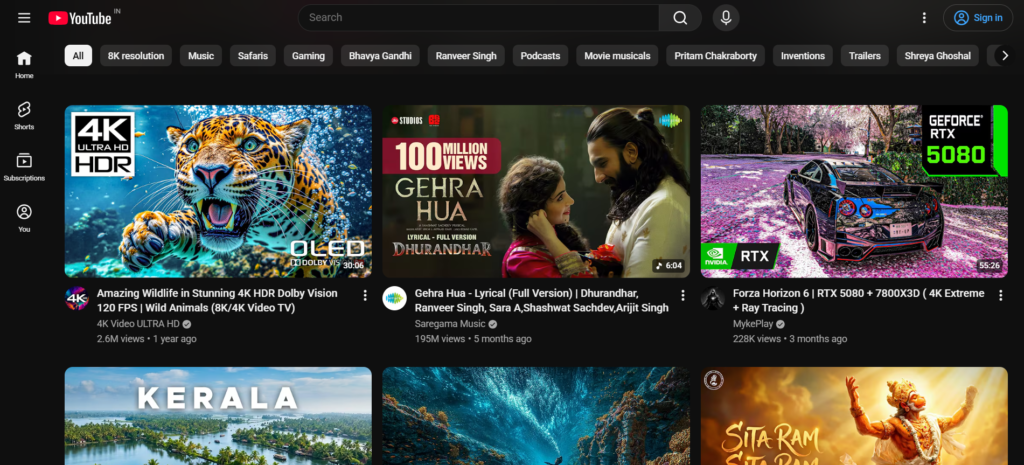
YouTube still wins when discoverability is more important than controlling the brand. It’s entirely free, really doesn’t have any significant storage limitations for most companies and puts your content in front of the largest video audience anywhere on the internet with a recommendation engine that can result in your videos popping up in front of people who never searched for your brand. For awareness content at the top of the funnel, nothing else on this list even approaches that reach.
The tradeoff is control. Videos exist within YouTube’s world; competitor advertisements can be served up next to your video, and the recommended video feature can result in your viewers not being focused on your message. It is a great complement to a stand-alone business hosting platform but seldom a complete replacement.
Key Features:
- Unlimited free video hosting and bandwidth
- Massive built-in audience and discovery engine
- Live streaming and premiere scheduling
- Video SEO benefits from search and suggested content
- Monetisation options for eligible channels
Pros:
- Completely free with no storage limitations
- Unmatched audience reach and discoverability
- Familiar interface that viewers already know how to use
- Strong for organic search and video SEO
Cons:
- No brand control over ads or suggested videos
- Not designed for private or internal business content
- Limited customisation compared to dedicated hosting platforms
- Analytics are geared toward creators, not lead generation
Pricing:
Free; has no paid hosting level; monetise/advertising possibilities available independently.
4. Vidyard
Rating: 4.5/5
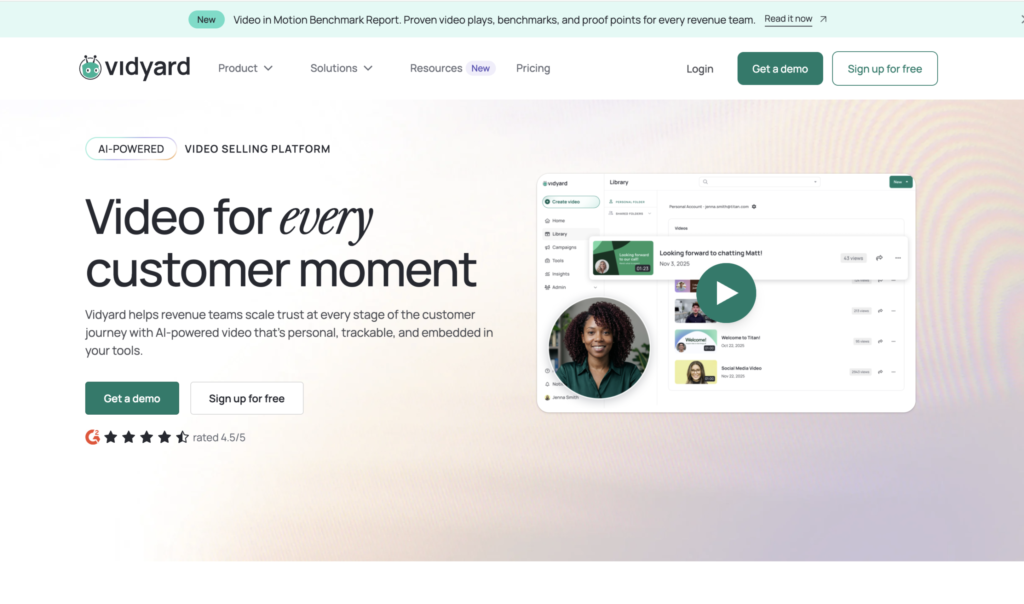
Aside from the other few features, at its heart Vidyard is just about a single use case: Providing sales, marketing and customer success teams the platform they need to scale the creation and distribution of personalised video. The rep records a brief video, directly from Gmail, HubSpot, or Salesforce, and tracking data of opens, views and clicks feeds back into the CRM. Automated, AI enabled video that plays when a buyer responds to an action, such as to book a call or download content, delivers a level of personalisation that basic hosting tools can’t.
The free plan is actually really helpful for a rep just getting started (although it limits the number of videos you can upload and has the Vidyard logo). G2 reviewers also mention its integrations with sales tools as a major plus, along with the per-seat pricing for paid plans.
Key Features:
- One-click personalised video recording and sharing
- CRM native workflows like HubSpot, Salesforce, Gmail, Outlook
- Buyer engagement analytics and intent signals
- AI generated video for automated outreach
- Video trimming and quick editing tools
Pros:
- Purpose built for sales engagement and outreach
- Deep CRM integrations that log engagement automatically
- Easy enough for non-technical sales reps to adopt quickly
- Useful free plan for individuals testing the platform
Cons:
- Free plan limits total video uploads
- Per-seat pricing scales quickly for larger teams
- Less suited to general marketing or public-facing hosting
- Embedding options are more limited than dedicated hosting tools
Pricing:
- Free: $0
- Starter: $59/seat/month
- Video Agent Add-on: $24/seat/month
- Teams: Custom pricing
- Enterprise: Custom pricing
5. Brightcove
Rating: 4.1/5
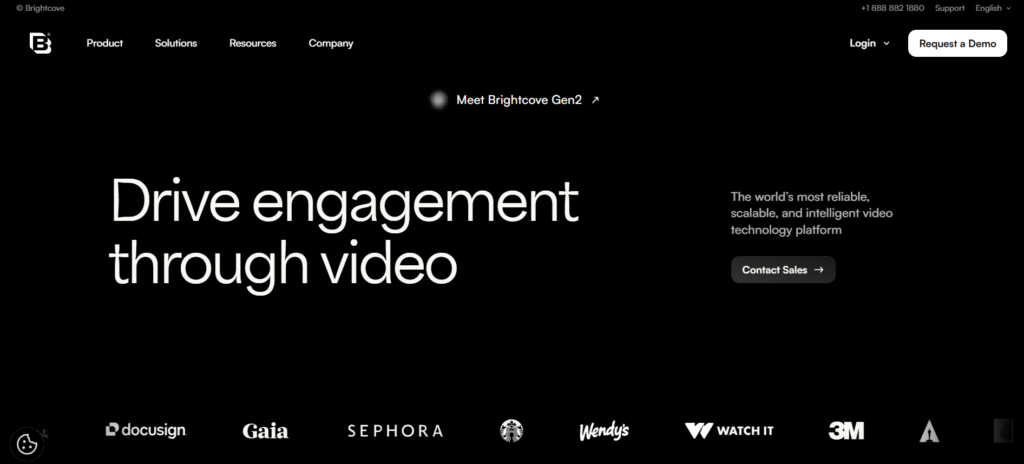
Brightcove is designed for organisations broadcasting video at true enterprise scale, such as a media company, large enterprise, or OTT service operating a large-to-massive video library across web, mobile and connected TV. It provides worldwide CDN delivery, adaptive bitrate delivery, DRM and tokenised security, and an AI content platform that automates metadata tagging and captioning across large libraries.
Pricing is completely usage based and tailored around bandwidth, storage, and play volume, with business deals usually ranging from $20,000 to several hundred thousand dollars per year. Such pricing makes sense for media and large enterprise deployments, but puts Brightcove completely out of reach for the majority of small and medium sized businesses.
Key Features:
- Global CDN with adaptive bitrate streaming
- DRM and token-based content security
- AI-powered metadata tagging and captioning
- Developer APIs and SDKs for custom integrations
- Monetisation tools for media and OTT deployments
Pros:
- Built for true enterprise-scale video delivery
- Strong security and access control options
- High platform uptime and reliability, per SLA data
- Deep customisation through APIs and SDKs
Cons:
- Pricing is opaque and requires direct sales negotiation
- Far too costly for small or mid sized businesses
- Longer implementation timelines than lighter platforms
- Reviewers note reporting and analytics could be stronger
Pricing:
Custom, usage-based pricing.
Matching Platforms to Your Video Strategy
Choosing the right video hosting platform is a matter of your content strategy, your audience and your business goals. For instance, if you are a brand that prefers to maintain clean, well-produced videos without advertisements, Vimeo would be the most suitable platform. Wistia would be a better option for marketing teams interested in generating leads.
YouTube is still the best for public reach and brand awareness. If you’re a sales team using personalised video, then Vidyard is effective, but if you’re an enterprise with a multi-channel and multi-audience need, then Brightcove is built for large-scale broadcasting, streaming and media distribution.
Video Hosting Features That Matter
When evaluating all of the different features offered by video platforms, consider how they stack up to your real world needs in the following areas: video storage, embeddability, player customisation, privacy options, statistics/analytics, lead generation, video SEO, team collaboration, API access, integrations with third party applications. The requirements of a small marketing team will be quite different than those of a large media enterprise.
Also Read: Best Video Content Management System(CMS)
Business Video Hosting vs. YouTube
The fundamental trade-off is between control and reach. Business hosting tools such as Vimeo and Wistia give you complete control of branding and no competing ads, as well as great analytics linked to lead conversion-but require you to grow your own audience. YouTube provides free, practically unlimited hosting and discoverability, but content is locked into YouTube, with ads, recommended videos, and no private lead-grabbing tools.
In many cases, people end up having two: one with YouTube for general awareness content often repurposed using YouTube converter tools and one with a more dedicated video hosting solution for gated, branding and sales content
Comparing Video Hosting Costs
Pricing in this must is all over the place. There are free plans with real limitations (YouTube, Wistia, Vidyard), subscription-based pricing based on storage or bandwidth (Vimeo, Wistia), per-user plans meant for sales-focused tools (Vidyard) and fully custom enterprise pricing for huge-scale broadcasting (Brightcove).
Be aware of any additional charges for bandwidth, additional seats, and marketing automation extras that aren’t included in the plan.
Steps to Choose a Video Hosting Platform
- Identify what are the main objectives of your video Like marketing, sales, broadcasting so on.
- Estimate your expected video storage and bandwidth needs
- Identify whether your audience is public or private
- Determine how detailed your analytics requirements are
- Review the security and access controls you need
- Assess how important marketing or lead gen features are
- Check integrations with your existing CRM or marketing stack
- Calculate long term costs, not just the advertised starting price
Video Hosting Developments to Watch in 2026
AI is transforming the ways businesses use and analyse video this year, and it’s not just hosting platforms catching up video editing software has moved just as fast. Look for broader adoption of AI driven analytics that automatically identify engagement trends, use of interactive video with click-to-insight features and customised viewing experiences.
Automation features such as automated transcription, insight rich engagement data, video commerce capabilities, and AI driven management of content are rapidly turning into basic features instead of costly add-ons.
Final Verdict
No one video hosting platform is right for every organisation. If you want a polished branded experience, then Vimeo is a great choice. Wistia is geared toward marketing videos and generating leads. YouTube is best suited to reach the public, Vidyard is geared toward sales support, and Brightcove is a perfect choice for large scale enterprise broadcasting.
Choose the plan that makes the most sense for you by balancing how much you want to accomplish with how much time, money, and effort you’re willing to put in. If you can, always start with a free account or free trial where available and move up when it’s clear your video hosting requirements are more advanced.
FAQs
1. What is the best video hosting platform for businesses?
Of all the options, Vimeo is the best choice for most professional, brand-controlled video hosting, but the best choice for marketing and lead generation use cases is Wistia.
2. What is the best free video hosting platform?
YouTube provides the most comprehensive free hosting without a real storage limit; however, for business, Wistia’s free plan is more attractive with its slick branding and simple analytics.
3. Is Vimeo better than YouTube for business videos?
Absolutely for private, branded or client-facing material. Vimeo has an ad-free, less accessible service with more privacy controls than YouTube, but YouTube is naturally much more discoverable.
4. What is the best platform for private business videos?
Vimeo is likely to be the best solution for private, password protected business videos thanks to its granular privacy controls and a player free from advertisements.
5. Which video hosting platform is best for marketing
Designed specifically for video marketing, Wistia includes lead capture forms, engagement heatmaps and A/B testing as standard.